When status = 'pending' Stops Being Enough — Laravel + Petri Nets in Three Real Apps
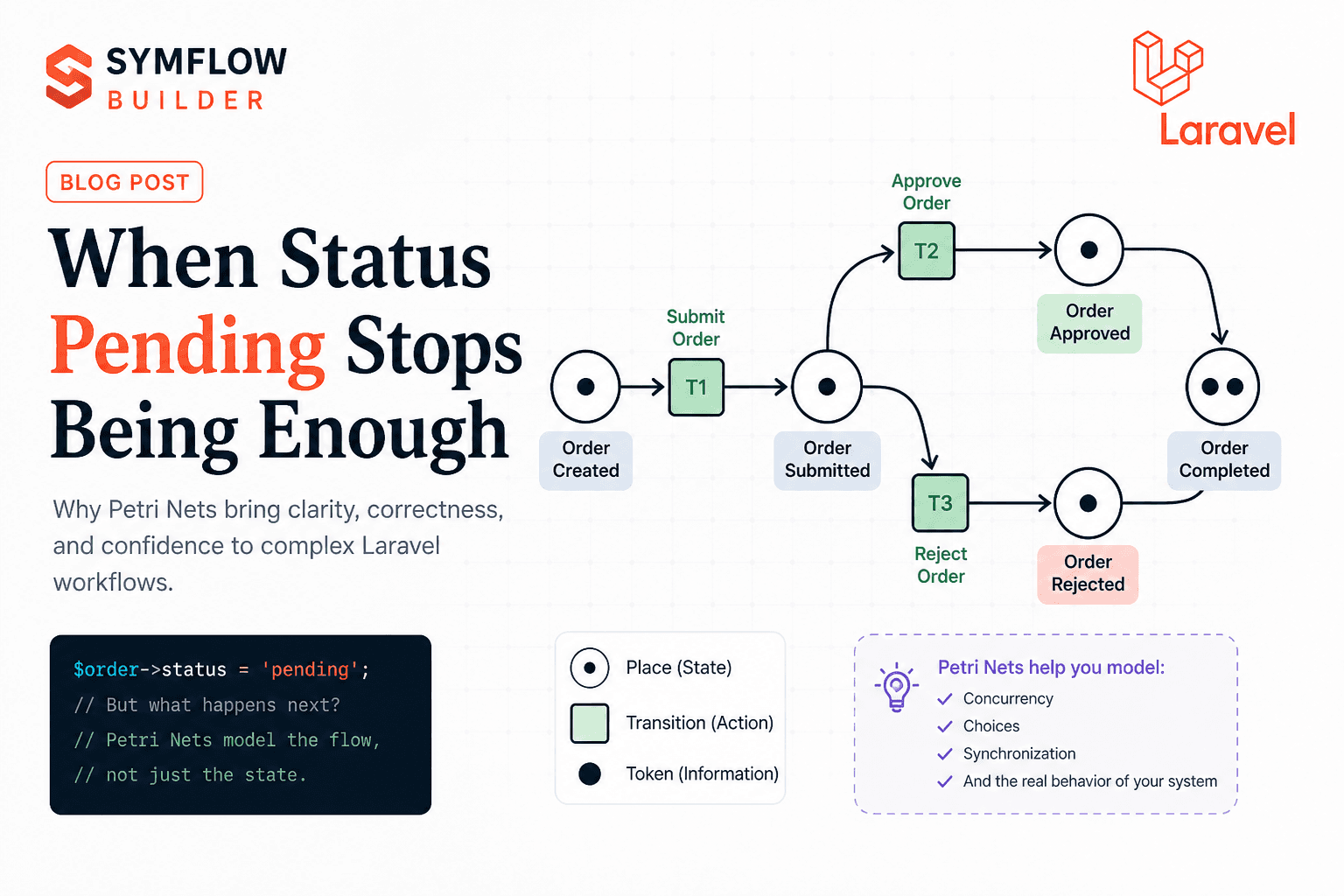
Why every Laravel app eventually outgrows the status enum, and what a real workflow engine looks like underneath.
You've written this enum before:
enum OrderStatus: string {
    case Cart      = 'cart';
    case Pending   = 'pending';
    case Paid      = 'paid';
    case Shipped   = 'shipped';
    case Delivered = 'delivered';
    case Cancelled = 'cancelled';
}
It works. Until the order has to be paid and shipped and awaiting customs clearance, simultaneously. Until the customer requests a refund after delivery, and "refunded" doesn't fit on the same axis as "delivered." Until your if ($order->status === ...) chain has 14 branches and three of them are commented // FIXME: not really sure when this happens.
The first time I hit this, I added a second status column. Then a third. Then a metadata JSON blob for "things that don't fit." Then I realized I was reinventing — badly — what Symfony's Workflow component had been doing for a decade.
This is the story of symflow-laravel — a Symfony-compatible workflow engine for Laravel — and three runnable demos I built on it that turn into the three patterns every status field eventually becomes: parallel review, parallel check, and multiple concurrent lifecycles.
What a workflow engine is, in 90 seconds
Forget orchestrators and queue runners. A workflow engine, in this sense, models states and transitions as first-class data structures:
- Places — the named states something can be in (
draft,code_review,qa_review) - Transitions — named operations that move tokens between places (
submit,approve_code,merge) - Marking — which place(s) currently hold a token
Two flavors:
- State machine — exactly one active place at a time. The classic on/off/standby radio.
- Workflow (Petri net) — multiple places can be active at once. The transition
submit_for_reviewcan put tokens in bothcode_reviewandqa_review, and a latermergecan require a token from each before firing.
That second flavor is where things get interesting, because it lets you say things your status field cannot: "this issue is simultaneously waiting on a code review and a QA review." Your domain model gets to be honest.
symflow-laravel brings exactly that to Laravel — same place/transition/guard/event vocabulary as Symfony's own Workflow component, same YAML import format, but PSR-12 classes, Eloquent integration, and an Artisan toolbox.
composer require vandetho/symflow-laravelDemo 1: expense approval, parallel reviewers
The first place I'd reach for a Petri net in a real Laravel app is anything where multiple parties have to sign off concurrently. Expense approval is the canonical example: legal, finance, and management all need to weigh in, and there's no good reason to make them queue up.
The workflow:
                  ┌─ legal_review   ─── approve_legal   ─── legal_approved   ─┐
                  │                       [role:legal]                        │
draft ── submit ──┼─ finance_review ─── approve_finance ─── finance_approved ─┼── finalize ── approved ── pay ── paid
                  │                       [role:finance]                     │                       [role:finance]
                  └─ manager_review ─── approve_manager ─── manager_approved ─┘
                                          [role:manager]
submit is the AND-split — it puts a token in all three review places. finalize is the AND-join — it consumes one from each *_approved place and produces a single token in approved. In between, three roles approve in any order, in parallel.
Try expressing that with a status enum. You can't. You'd end up with something like status_legal, status_finance, status_manager — which is a Petri net with terrible bookkeeping.
In symflow-laravel, this is just config:
'expense_approval' => [
    'type' => 'workflow',
    'marking_store' => ['type' => 'property', 'property' => 'marking'],
    'supports' => App\Models\ExpenseRequest::class,
    'initial_marking' => ['draft'],
    'transitions' => [
        'submit' => [
            'from' => ['draft'],
            'to'   => ['legal_review', 'finance_review', 'manager_review'],
        ],
        'approve_legal' => [
            'from'  => ['legal_review'],
            'to'    => ['legal_approved'],
            'guard' => 'role:legal',
        ],
        // ... etc
        'finalize' => [
            'from' => ['legal_approved', 'finance_approved', 'manager_approved'],
            'to'   => ['approved'],
        ],
    ],
],
The guard: 'role:legal' syntax is just a string — you write a GuardEvaluator class that interprets it however you want. In the demo, mine reads auth()->user()->hasRole($x) and returns a GuardResult with a structured reason code (not_authenticated, wrong_role, etc.) so the UI can show why a button is disabled.
Try it: https://github.com/vandetho/symflow-laravel-expense-approval
Demo 2: issue tracker, parallel review
If "expense approval" feels niche, the same pattern lives at the heart of every dev tool you've ever used. Code review and QA review run in parallel. Both have to pass before merge. If either rejects, the issue closes. That's a Petri net.
                                              ┌─ code_review ── approve_code ── code_approved ─┐
                                              │                 [role:reviewer]                │
open ── start_work ── in_progress ── submit ──┤                                                ├── merge ── merged
                                              │                                                │   [role:reviewer]
                                              └─ qa_review ──── approve_qa  ─── qa_approved ───┘
                                                                 [role:qa]
In a status enum world, you'd be tempted to invent ten dot-permuted statuses (code_pending_qa_pending, code_approved_qa_pending, code_pending_qa_approved, ...). With Petri-net semantics you just have places, and the marking is whichever places currently hold a token. The same merge transition fires when both code_approved and qa_approved have tokens — that's literally what AND-join means.
The repo: https://github.com/vandetho/symflow-laravel-issue-tracker
I built it with the same scaffolding pattern as the expense demo:
- A
RoleGuardEvaluatorthat parsesrole:Xand returnsGuardResultobjects - An
AuditLogMiddlewareattached via$workflow->use($mw)— three lines of business logic, capturing actor + before-marking + after-marking on every transition - A
WorkflowServiceProviderthat overrides the package's default registry to inject the guard and middleware - A Livewire detail page that groups transition buttons into "Available now" / "Awaiting another actor" / "Not in this state" — so you never see a confusing wall of disabled buttons. Each button shows the exact reason it's disabled, lifted straight from the
GuardResultorTransitionBlocker.
The "Awaiting another actor" group is the real win. Someone opens an issue waiting on QA and sees: "approve_qa — Requires the qa role." No magic, no UI guessing — the engine told you.
Demo 3: order lifecycle, *three* concurrent workflows
The first two demos showed off Petri-net semantics. The third is the one that broke my mental model the first time I built it.
E-commerce orders have at least three independent lifecycles:
- The order itself —
cart → placed → shipped → delivered → completed(state machine) - The payment —
unpaid → authorized → captured → refunded(state machine, can fail and retry) - The fulfillment —
queued → [picking ∥ packing] → ready(Petri net — pickers and packers work in parallel)
These are independent. Payment can be captured while fulfillment is still picking. The order can be delivered and the payment refunded at the same time. Encoding all of this in a single status field would be insane — you'd need either a 50-case enum or some state flags array that fights you every time you query.
symflow-laravel lets you register multiple workflows for the same model, each with its own marking column:
'workflows' => [
    'order_lifecycle' => [
        'type' => 'state_machine',
        'marking_store' => ['type' => 'property', 'property' => 'lifecycle'],
        'supports' => App\Models\Order::class,
        // ...
    ],
    'order_payment' => [
        'type' => 'state_machine',
        'marking_store' => ['type' => 'property', 'property' => 'payment'],
        'supports' => App\Models\Order::class,
        // ...
    ],
    'order_fulfillment' => [
        'type' => 'workflow', // Petri net
        'marking_store' => ['type' => 'property', 'property' => 'fulfillment_marking'],
        'supports' => App\Models\Order::class,
        // ...
    ],
],
Three columns on orders: lifecycle (string), payment (string), fulfillment_marking (JSON for the Petri net). Three independent state spaces. Firing transitions on any of them is just:
$order->applyTransition('place');                     // default workflow
$order->applyTransition('authorize', 'order_payment');
$order->applyTransition('start_fulfillment', 'order_fulfillment'); // splits into picking + packing
The detail page in the demo renders three diagrams stacked — one per workflow, each highlighting its own active places. Below them, a single combined audit timeline color-codes every transition by which workflow fired it (sky for lifecycle, emerald for payment, orange for fulfillment), all written by the same AuditLogMiddleware. The trick: capture $context->workflowName from the middleware context so a single audit table works across all three.
The repo: https://github.com/vandetho/symflow-laravel-order-lifecycle
The interesting seeded order is ORD-1002 — lifecycle=placed, payment=authorized, fulfillment=picking,packed. That last one is a Petri-net mid-flight: picker hasn't finished yet but the packer already prepared the box. You can't say that with one column.
Designing workflows visually
Workflows-as-config is great for diffs and code review, but it's a lousy way to think about a state machine. So the same author also built symflowbuilder.com — a free, drag-and-drop visual editor. React Flow canvas, places + transitions, exports the exact same Symfony YAML format symflow-laravel reads. No account needed.
Each of the three demos is published there:
- Expense approval
- Issue tracker
- Order lifecycle / payment / fulfillment (three separate canvases)
And here's the part I'm most excited about: the editor's /embed/{shareId} route accepts a ?marking=place_a,place_b query param. The detail page in each demo embeds the canonical SymFlowBuilder canvas as an iframe and rebuilds the URL per record, so the canonical canvas lights up the same places the host's local Mermaid render highlights:
<iframe src="https://symflowbuilder.com/embed/86b557637fa5a7aa
  ?branding=0&minimap=0&scenario=0
  &marking=code_review,qa_review">
</iframe>
Open the live embed in a new tab — the issue tracker locked in [code_review, qa_review], both places pulsing on the canonical canvas. Change the ?marking= value in the URL bar and the highlights follow.
Every detail page now ships two diagrams per workflow: a fast local Mermaid render that the engine drives directly, and a live iframe of the canonical canvas that the host populates by URL. Same colors, same active places, two completely independent rendering paths. The whole loop closes.
What it actually costs to ship this
The package is small enough to read in an afternoon. The three demos compose to roughly:
- ~5 files of "engine glue" per app:
RoleGuardEvaluator,AuditLogMiddleware,WorkflowReasonContext,WorkflowServiceProvider, plusWorkflowDescriptorfor the multi-workflow case - Workflow configs in
config/laraflow.php(or YAML if you prefer) - A handful of Livewire components for the UI (
Dashboard,OrderShow,WorkflowSection,WorkflowDiagram)
That's it. The Petri-net theory is in the package; you're just choosing places, transitions, and how to express your guards. Once written, you don't have to touch the engine again — adding a new state means adding one line of YAML, not a switch everywhere.
All three repos ship a Dockerfile (FrankenPHP) and fly.toml so deploy is one command on Fly.io's free allowance:
fly launch --no-deploy --copy-config
fly volumes create expense_data --size 1
fly secrets set APP_KEY="base64:$(openssl rand -base64 32)"
fly deploy
auto_stop_machines = "stop" puts each demo to sleep when nobody's looking, so a free Fly account can host all three concurrently.
When you should reach for this
If your app has a status field and:
- Two reviewers/approvers/checkers can run in parallel — you want a Petri net.
- Different aspects of the same entity have different lifecycles — you want multiple workflows on one model.
- You need to answer "why didn't this transition fire?" in your UI — you want the structured
GuardResultcodes. - You'd like to inspect "what happened to this thing?" in one query — middleware-driven audit beats sprinkled
Log::infocalls.
If your app has three statuses and one transition between them — you don't need this. A status enum is fine. There's no free lunch in adding an engine; you trade if/else for primitives. The win compounds when domain complexity does.
Try them
- 📦 The package: https://github.com/vandetho/symflow-laravel
- 💸 Expense approval (parallel reviewers): https://github.com/vandetho/symflow-laravel-expense-approval
- 🐞 Issue tracker (code-review + QA): https://github.com/vandetho/symflow-laravel-issue-tracker
- 📦 Order lifecycle (three concurrent workflows): https://github.com/vandetho/symflow-laravel-order-lifecycle
- 🎨 Visual editor: https://symflowbuilder.com
Each demo has seven seeded records spanning every workflow state, a role switcher to flip between actors, and npm run build && php artisan serve boots in 30 seconds. Click through one for ten minutes. If your status field has been quietly accumulating workarounds, you'll know whether it's time to retire it.
I write about Laravel internals, workflow engines, and the gap between docs and "but how do I actually wire this up." If that's your kind of problem, follow on Medium.